
How to Do Mold Encapsulation Right (Don't Hide the Mess)
Mold encapsulation without a clearance plan is like putting a lid on a dirty pot; it hides the mess but doesn't fix it. To truly protect your home, you must address moisture, treat existing mold, and verify cleanliness before sealing to prevent hidden decay and poor air quality issues.
Why is encapsulation without cleaning a bad idea?
Imagine you just finished a massive Sunday dinner. There’s lasagna crust burned onto the bottom of your favorite pot, and the sauce has reached levels of stickiness previously unknown to man. Instead of scrubbing it, you simply slap a shiny, airtight lid on it and shove it into the back of the pantry. You can’t see the mess, and for a few days, you can’t smell it either. But we all know what’s happening in that dark, humid micro-universe. You aren't storing leftovers; you are hosting a science experiment that will eventually involve a hazmat suit and a priest.
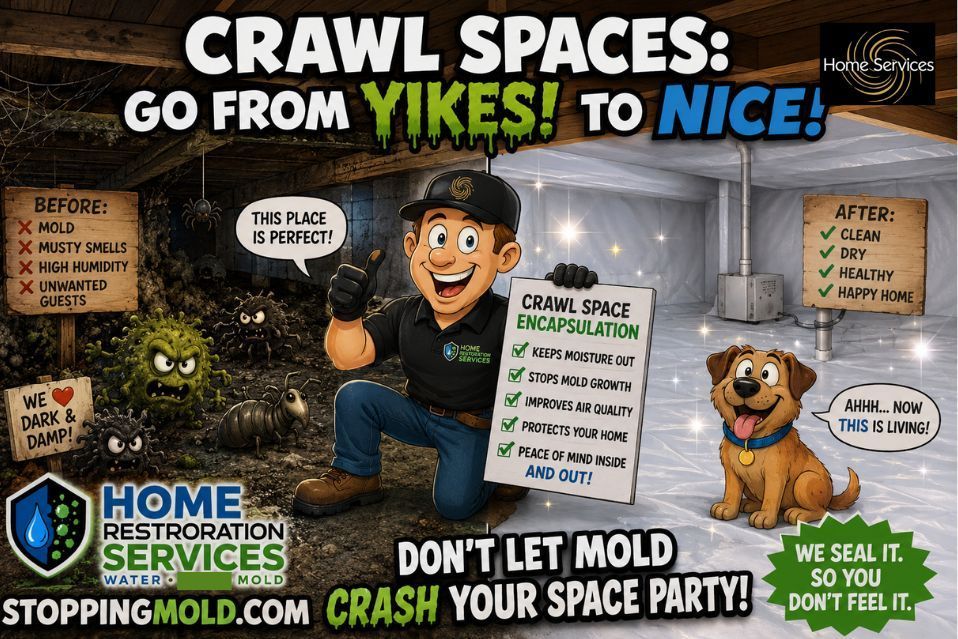
This is exactly what happens when homeowners or "budget-friendly" contractors perform mold encapsulation without a proper mold remediation and clearance plan. Encapsulation is the process of sealing surfaces (usually in a crawl space or attic) with a specialized coating or heavy-duty plastic vapor barrier. When done correctly, it’s a miracle of modern home science. When done poorly—without cleaning the mold first—it is literally just putting a lid on a dirty pot.
If you seal live mold spores behind a white plastic sheet or under a layer of paint-like sealant, you aren't "fixing" anything. You are just giving the mold a private, VIP lounge where it can continue to eat your floor joists in peace. Without a clearance plan—which involves professional testing and verification that the mold is actually gone—you’re just gambling with your home's structural integrity.
The Dirty Pot Theory: Hidden Mold Hazards
When we talk about the "Dirty Pot Theory," we’re highlighting the fundamental flaw in skipping the prep work. In the world of Crawl Space & Attic Services , the prep work is 90% of the battle. If a contractor tells you they can just "spray and seal" without a comprehensive plan to remove the existing contamination, they are selling you a very expensive magic trick.
Here is what happens when you skip the clearance phase:
- The Hidden Feast: Mold doesn't need much to survive—just a little organic material (like your wood joists) and a bit of moisture. Sealing it in doesn't always kill it; it often just traps it against the wood.
- Structural Decay: While you’re upstairs enjoying your "repaired" home, the mold is busy breaking down the cellulose in your wood. This leads to the need for Joist Repair down the road.
- False Security: You see a clean, white crawl space and think you’re safe. Meanwhile, the air quality in your home might still be compromised as gasses from the mold (MVOCs) seep through gaps and into your living space.
- Resale Nightmare: Eventually, you’ll try to sell your house. A home inspector will see that "clean" crawl space, look a little deeper, and find the fuzzy surprise lurking behind the curtain. Good luck closing that deal.
- The Cost of Redo: Doing it twice is always more expensive than doing it once. Removing an encapsulation system to fix the mold you ignored the first time is a financial gut-punch.
What should a professional clearance plan include?
So, what does a real plan look like? It’s not just a guy with a spray bottle and a dream. At Home Restoration Services, we believe in the "Trust, but Verify" method. Our process is designed to ensure that when we put that lid on the pot, the pot is so clean you could eat off it (though we don't recommend eating off your crawl space floor).
A legitimate clearance plan follows a logical flow of moisture control , cleaning, and testing. Here is the breakdown of what you should expect from a pro in Southern MD :
- Source Identification: Before we touch a single spore, we find out why they’re there. Is it a foundation crack? A leaky pipe? High humidity? We tackle the moisture source first.
- Physical Removal: We don't just spray chemicals and walk away. Mold must be physically removed from surfaces using HEPA vacuuming, wire brushing, or media blasting. This is the "scrubbing the pot" phase.
- Antimicrobial Treatment: Once the bulk is gone, we treat the surfaces with professional-grade antimicrobials to kill any lingering microscopic spores.
- Verification (The Clearance): This is the big one. An independent Indoor Air Quality Testing or a post-remediation verification (PRV) ensures the area is actually clean. Only then do we proceed to encapsulation.
- The Seal: Finally, we install the vapor barrier and perhaps a Dehumidification system to keep the space dry forever.
Why moisture control is the real MVP
You can clean mold until your hands are raw, but if the humidity in your Calvert County basement stays at 80%, that mold is coming back like a bad 80s fashion trend. Moisture is the lifeblood of mold. This is why we don't just focus on the mold; we focus on the environment.
In our region, the humidity can be brutal. A crawl space that isn't properly managed acts like a giant sponge, soaking up water from the Maryland soil and the thick summer air. If we don't address that, any remediation we do is just a temporary band-aid. We use high-grade Foundation Crack Repair and structural solutions like Foundation Wall Repair to ensure that water stays outside where it belongs.
How do we keep mold from returning for good?
The secret sauce to a mold-free home isn't a secret at all—it’s science and sweat. Keeping mold away requires a multi-pronged attack. Once we’ve cleaned the space and passed our clearance test, the encapsulation acts as a permanent shield.
We install a heavy-duty vapor barrier that covers the floor and wraps up the walls. This creates a physical break between the damp earth and your home’s wooden skeleton. But the barrier is only half the battle. We also recommend a dedicated SaniDry dehumidifier. Think of it as a security guard for your air, constantly patrolling for moisture and kicking it out of the house.
If you have a history of water issues, we might even suggest Water Damage Mitigation steps like sump pumps or improved drainage. When you combine physical removal, moisture control, and a high-quality seal, you create an environment where mold simply cannot survive. It’s like trying to start a campfire in a swimming pool—it’s just not going to happen.
Cost vs. Value: Doing Remediation Right
We get it. You see a quote for "Spray and Seal" for $2,000 and our quote for a full remediation and clearance plan for more, and your wallet starts to hyperventilate. But let’s look at the math. If you spend $2,000 to hide the problem, and two years later your floor joists are rotting because you trapped moisture and mold inside, you’re now looking at a $15,000 bill for Structural Repairs .
Because Home Restoration Services holds a Maryland Home Improvement Commission (MHIC #143012) license, we don't just "clean." We are qualified to rebuild. If your mold problem has already turned your joists into something resembling soggy oatmeal, we can handle the remodeling and structural fixes. We aren't just remediation guys; we are builders. This means our plans are comprehensive. We aren't just looking at the fuzzy stuff; we’re looking at the bones of your house.
When you invest in a proper clearance plan, you are paying for peace of mind. You are paying for a home that won't make you sneeze, won't fall down, and won't fail a home inspection when it's time to sell. That is true value. Plus, we’re a lot more fun to work with than the guys who just want to paint over your problems and run.
The Maryland Factor: Why St. Mary’s and Charles County are Different
If you live in St. Marys County MD or Charles County MD , you know that "dry" is a relative term. We live in a coastal-adjacent swamp, let's be honest. Our crawl spaces face challenges that a house in Arizona will never know. Between the high water table and the humidity that you can practically chew, mold loves it here.
This is why a "one-size-fits-all" approach from a national franchise often fails. They don't understand the specific hydrostatic pressure issues of our local soil or the way the Chesapeake breeze carries moisture into every nook and cranny. We live here, we work here, and we’ve seen what happens when local homes are treated like they’re in a different climate. We tailor our moisture control and encapsulation plans to handle the specific insanity of Maryland weather.
Final Takeaways for Maryland Homeowners
Wrapping up your mold journey doesn't have to be a nightmare. If you remember the dirty pot analogy, you’re already ahead of 90% of other homeowners. Don't let anyone convince you that sealing is a substitute for cleaning. It is the final step, not the only step.
To ensure your home remains safe and structurally sound, keep these points in mind:
- Always demand a clearance plan that includes physical removal and verification.
- Fix the water source before you worry about the aesthetic of the seal.
- Verify the contractor’s license (MHIC is a must in Maryland for structural work).
- Invest in long-term moisture control like dehumidifiers and proper drainage.
- Don't ignore the signs like musty smells or bouncy floors; they only get worse.
If you’re worried that your crawl space is currently a "dirty pot" with a lid on it, or if you want to make sure your first remediation is your last, give us a call. We’ll help you clean the pot, dry it out, and seal it up so you never have to think about it again. Check out our FAQs for more info or head to our Contact page to get started!